There is a specific kind of anxiety that comes with metered AI tooling. You stop sending the prompt you actually want to send because you are doing math in your head about how many credits it will burn. Then your app ships, real users show up, and you discover that the app itself is now metered too, quietly draining a balance while you sleep.
That second part is the new part. Lovable moved to a single credit balance that pays for two different things: messaging the AI to build your app, and keeping your shipped app running. The first cost everyone already knew about. The second one, the “run credits”, is the one catching people off guard, and it is why r/lovable has gotten loud this week.
To be fair up front: Lovable is a genuinely good prototyping tool. The problem here is the cost model once you actually run a real, database-backed app, not the product itself. This post covers what changed, the actual mechanics (with the user-reported numbers attributed where they should be), and a different way to do the same thing: build with a coding agent in your browser using your own Claude or Codex subscription, then run the app on a flat-priced server with no per-query metering.
Quick answer
Lovable now meters both building and running your app out of one credit balance. Building burns credits per message (complexity-priced), and a separate “run credits” category meters your deployed app’s Cloud usage continuously: Database, Network, Storage, Edge Functions, and Realtime, even when you are not actively building. Every plan includes a monthly grant of 20 Cloud credits; past that, running comes out of your balance.
The InstaPods alternative removes both meters. Building has no credits because you connect your own Claude Code or OpenAI Codex CLI, signed in with your own account or API key, so InstaPods takes zero cut of your AI usage and adds no per-message limit. Running has no credits because a pod is a flat monthly price (Launch $3, Build $7 with managed Postgres in the pod, Grow $15 adds Redis) with no per-operation, per-query, or per-run charges. That is the whole of flat versus usage-based pricing in one line: you pay for the server, not for what it does. Honest caveat: you bring your own Claude or Codex subscription or API key, which most devs in this audience already have.
What actually changed in Lovable
Lovable’s own documentation describes it cleanly: “Credits let you build apps, run deployed apps, and power AI features from one balance.” So a single pool now drains from three directions.
There are two meters worth understanding.
Build credits. Every message you send the AI costs credits, priced by complexity. From the documented build-mode examples: restyling a button runs about 0.50 credit, removing a footer about 0.90, adding authentication about 1.20, and building a landing page with images about 2.00. Plan-mode messages are a flat 1 credit each. Exact per-action costs vary by complexity and can change, so treat these as illustrative. A widely reported frustration in user reviews is that you cannot see what a prompt will cost before you send it; the deduction only shows after. One developer survey cited a single authentication bug that “could burn 15 credits that a manual code change would have resolved in minutes.”
Run credits. This is the new one. Per Lovable’s docs, “The Run credits view includes both Cloud and AI gateway usage,” and the chart “breaks Cloud usage into categories such as Database, Network, Storage, Edge Functions, and Realtime.” In plain terms: your deployed app’s database, storage, network, and backend functions burn credits as the app runs, measured by the infrastructure resources it consumes. Every plan (Free, Pro, Business) includes a monthly grant of 20 Cloud credits. Once your app exceeds that grant, further running comes out of your credit balance. One note on scheduling, since people assume otherwise: Lovable has no native cron or scheduler, so recurring jobs are done via Supabase Edge Functions, and that execution is metered as Cloud usage like everything else.
On price conversion, Lovable’s docs say prior dollar Cloud and AI balances were converted to credits at a plan rate: $0.25 per credit on Pro, $0.50 per credit on Business. Pro is reported at $25 per month (100 credits plus 5 daily); Business at $50 per month. Those dollar figures come from 2026 pricing guides and prior published pricing rather than the live pricing page itself, but they are corroborated across several sources.
The r/lovable account
Here is where I have to be careful. One builder on r/lovable reported the run-credit math on a database-heavy app: 100 EUR bought 400 run credits (0.25 EUR per credit), and they “burned 6.5 run credits in the first 24 hours, 95% database.” Extrapolated, that is roughly 195 credits a month, about 50 EUR a month just to keep the app running. They described the change as the old “$25/month free” cloud allowance becoming “20 credits per month … about 10% of what I need,” and summed it up as “nice simplification, shame about the doubling in price.”
I cannot independently verify those specific numbers, so treat them as one user’s firsthand account, not a fact about Lovable. What is verifiable is the structure: there is a real, documented run-credit meter on database and Cloud usage, and the monthly grant is 20 credits. The user’s 0.25 EUR per credit also lines up with the documented $0.25 Pro conversion rate, which is why the account is plausible.
Why this is structural, not a one-off
Almost every AI app builder in this category is also the AI vendor and the host. As of their current published pricing, the pattern tends to repeat: Bolt.new is token-based, so iteration cost scales with codebase size; v0 is credit-based on generations and steers you toward Vercel’s usage-billed runtime; Replit Agent uses effort-based agent spend on top of separate compute billing. The specifics differ and they change, but the shape is consistent. Build is metered because they resell your model tokens, and runtime is metered (or coupled to a usage-billed host) because they also own the hosting. Two meters, both pointed at you.
The InstaPods counter: kill both meters
InstaPods sits on the other side of both meters, and it does it by not being the AI vendor and not being a usage-billed host.
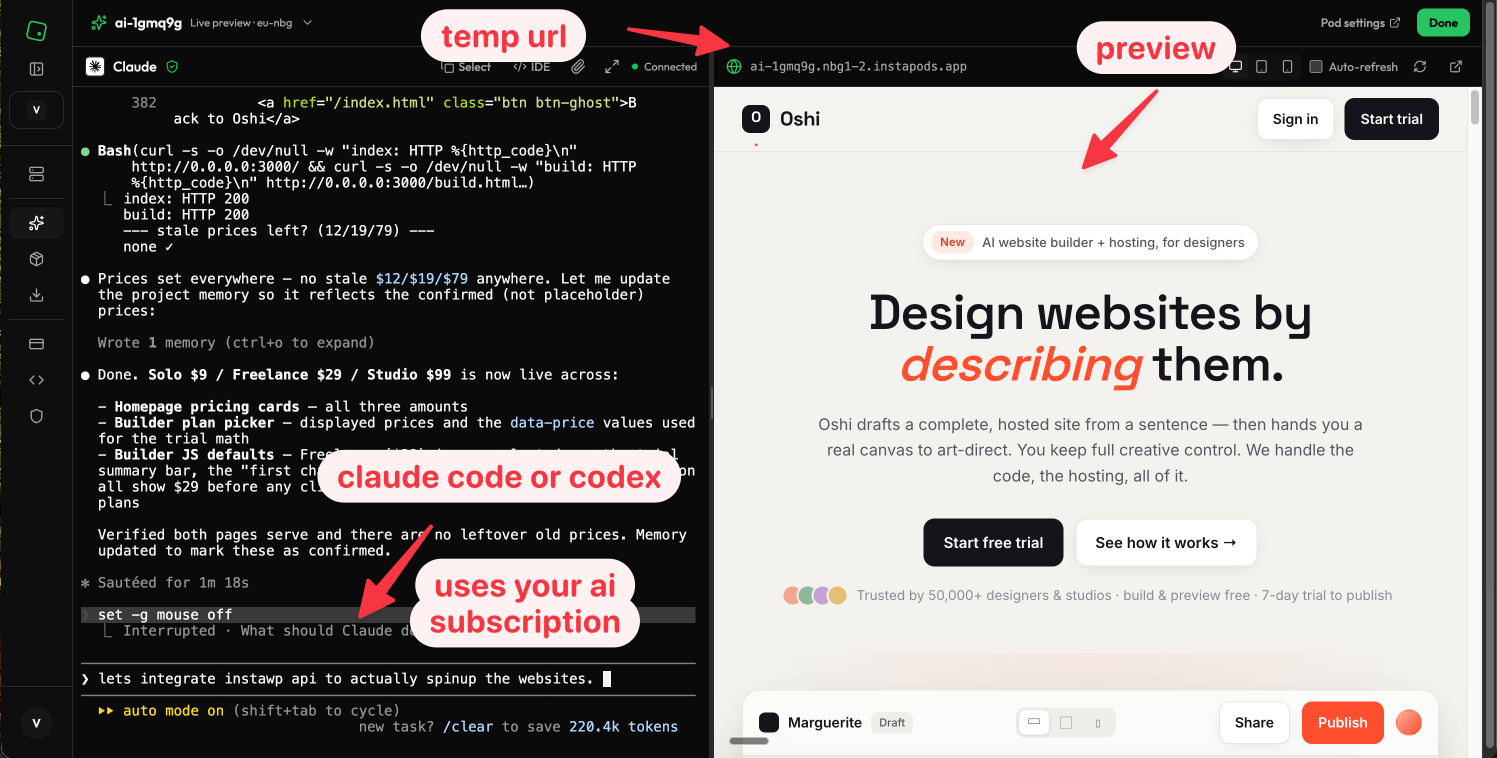
Build has no credits. InstaPods has a shipped AI builder at app.instapods.com/dashboard/ai. It is a split-screen browser experience: a web terminal running a coding agent on the left, a live preview of your app on the right at a temporary *.instapods.app URL that refreshes as you build. The agent is Anthropic’s Claude Code or OpenAI’s Codex CLI, running inside your own pod, signed in with your own Claude or OpenAI account (or your own API key). InstaPods is not the AI provider and takes zero cut of your AI usage. You already pay Anthropic or OpenAI directly, so there are no build credits, no per-message limits, and no token markup from us.
Run has no credits. Your app, its database, cron jobs, and background workers run 24/7 on a real Linux server at a flat monthly price. There is no per-operation, per-query, or per-run metering. A database-heavy app costs the same whether it serves 10 queries or 10 million. Pods are Launch $3, Build $7, Grow $15 per month. Build ($7) includes a managed Postgres in the same pod; Grow ($15) adds Redis. Managed Postgres, MySQL, and Redis are available with auto-generated credentials. Every pod is a real Linux server with auto-issued HTTPS, SSH access, and custom domains via one CNAME with automatic SSL.
The builder supports Node.js (Express, Next.js, full-stack), Static (HTML/CSS/JS), PHP 8.3, and Python (Flask/FastAPI). So it handles exactly the full-stack, database-backed apps that run credits hit hardest. Pods launch in seconds.
If what you are building is smaller than that, a single-page tool rather than a database-backed app, you may not need a builder pod at all. Claude can write the whole thing as an artifact in the chat, and deploying a Claude artifact as a real website puts it on a $3 pod with its own URL and SSL.
Cost model, side by side
| Cost dimension | Lovable | InstaPods AI builder |
|---|---|---|
| Building (messaging the AI) | Credits per message, complexity-priced (~0.50 to restyle a button, ~2.00 for a landing page) | No credits. Your own Claude Code or Codex CLI / API key. Zero AI cut from us. |
| Per-message limit | Capped by your credit balance and daily grants | None from InstaPods (your AI plan's own limits apply) |
| Running the deployed app | Run credits meter Database, Network, Storage, Edge Functions, Realtime continuously; 20 Cloud credits/mo grant | Flat monthly pod price. No per-query, per-run, or per-operation metering. |
| Database usage | Burns run credits as the app runs | Included flat. Same price at 10 or 10M queries. |
| Cron jobs / background workers | Via Supabase Edge Functions, metered as Cloud usage | Run 24/7 on the pod, no extra charge |
| Monthly price (entry) | Pro ~$25/mo, 100 credits + 20 Cloud grant | Build $7/mo flat |
| Who provides the AI | Lovable resells model tokens as credits | You do. Bring your own Anthropic/OpenAI account. |
Worked example: the ~50 EUR/mo database app
Take the r/lovable builder’s case as their own account: a database-heavy app projecting to roughly 50 EUR a month in run credits alone, on top of their plan. That is purely the cost to keep the app running, before you count any build credits spent iterating on it.
Run the same app on InstaPods Build at $7 a month, flat. That $7 includes a managed Postgres in the same pod, plus any cron jobs and background workers, with no run-credit metering on top. The database that drove 95 percent of those run credits in their account drives zero extra cost here, because reads and writes are not metered.
For building, you use the Claude or Codex subscription you likely already pay for. So the build side of the comparison is whatever your existing AI plan costs you, with no second markup layered on by the host.
To be precise about what InstaPods is not: it is not free. The honest pitch is no credits from us, you bring your own AI, and a flat pod price. That is the whole thing.
The honest caveat
Using the InstaPods builder requires your own Claude or Codex subscription or API key. That is a real prerequisite, not a hidden fee. If you do not already have one, that is a cost you take on directly with Anthropic or OpenAI, at their rates, with no InstaPods markup. Most developers reading this already have a Claude or ChatGPT plan, which is exactly why bring-your-own-AI works as a model. A builder pod is also a normal billable pod, so a payment method is required; the first card you add grants a one-time $10 credit. I would rather say all of that plainly than bury it.
Already have a Lovable app?
If you have already built something in Lovable and you just want cheaper, unmetered hosting for it, you do not need to rebuild anything. See how to deploy a Lovable app for the export-and-host path. For the broader picture on why metered, usage-billed hosting is a bad fit for AI-built apps, read why AI apps need new hosting, and for the general vibe-coded workflow, deploy a vibe-coded app. If Lovable is your starting point specifically, there is also a deploy from Lovable guide.
FAQ
What are Lovable run credits?
Run credits are Lovable’s term for the credits your deployed app consumes while it runs. Per Lovable’s docs, the Run credits view includes Cloud usage (Database, Network, Storage, Edge Functions, Realtime) and AI gateway usage, measured by the infrastructure resources your app uses. Every plan includes a 20 Cloud credit monthly grant; beyond that, running draws from your credit balance.
Did Lovable raise prices?
Lovable moved to a unified credit balance covering build, run, and in-app AI, and converted prior dollar Cloud/AI balances into credits ($0.25/credit on Pro, $0.50/credit on Business). One builder on r/lovable characterized this as “doubling in price” for their database-heavy app, but that is one user’s account, not a verified across-the-board price change.
How do I build an AI app with no credits?
Use a coding agent you already pay for. On InstaPods, the AI builder at app.instapods.com/dashboard/ai runs Claude Code or Codex CLI inside your own pod, signed in with your own account or API key. InstaPods does not provide or resell the AI, so there are no build credits and no per-message limits from the host.
Will a database-heavy app cost more on InstaPods?
No. A pod is a flat monthly price with no per-query or per-operation metering, so a database-heavy app costs the same whether it serves 10 queries or 10 million. Build ($7/mo) includes a managed Postgres in the same pod.
Do I need my own Claude or OpenAI account?
Yes. The InstaPods builder is bring-your-own-AI by design, so you sign in with your own Claude or Codex subscription or API key. That is a real requirement, not a hidden fee, and there is no InstaPods markup on your AI usage.
Is InstaPods free?
No. The pitch is no credits from us, you bring your own AI, and a flat pod price (Launch $3, Build $7, Grow $15). A builder pod requires a payment method, and your first card add grants a one-time $10 credit.
Build it without the meter
If the run-credit bill is what is bugging you, the fix is structural: stop paying a host that meters your tokens and your queries. Build with the AI subscription you already have, and run on a flat-priced server.
Open the builder at app.instapods.com/dashboard/ai, describe your app, and watch it come up at a live preview URL. No build credits, no run credits, just your own AI and a $7 pod.