Almost every website reaches for the same analytics tool by reflex: Google Analytics. It is free, it is everywhere, and it is what the tutorials tell you to paste in. But “free” has a price - your visitors’ behavioral data feeds Google’s advertising machine, you need a cookie-consent banner to stay compliant, and on a busy site GA quietly samples your data instead of counting every event.
There is a quieter path that a lot of teams move to once they care about privacy, ownership, or a consent-banner-free site: run your own analytics. The open-source tool for that is Umami, and you can now deploy your own on InstaPods in one click.
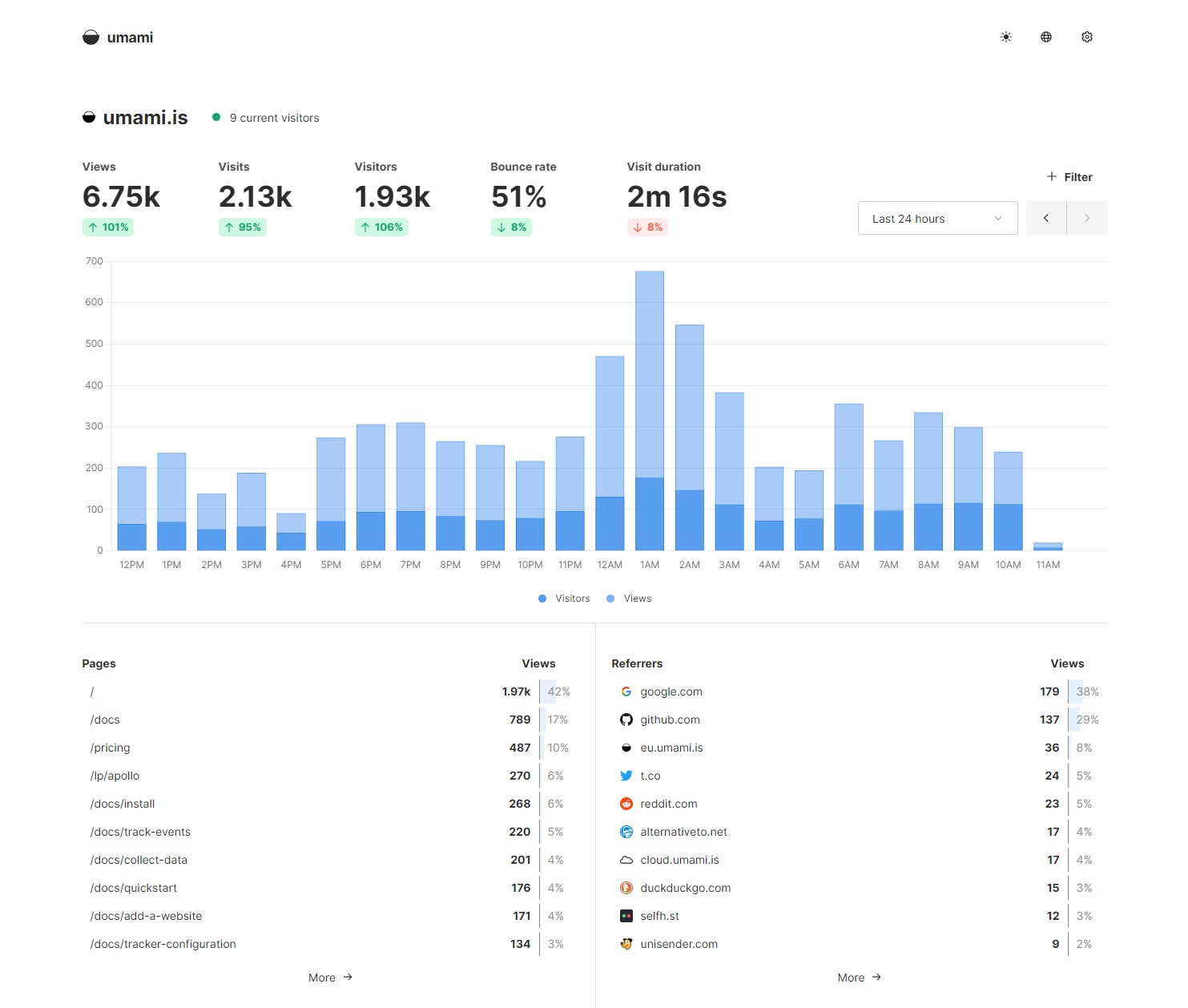
What Umami Actually Is
Umami is the open-source, privacy-first web analytics platform. Around 37,000 GitHub stars, MIT licensed, and built to answer the question most sites actually ask: how many people came, where from, and what did they look at?
It gives you a single clean dashboard with:
- Pageviews and unique visitors - counted, not sampled.
- Referrers and UTM campaigns - see exactly what’s driving traffic.
- Top pages, entry and exit pages - understand the journey through your site.
- Countries, browsers, and devices - the segmentation most teams use daily.
And it does all of that without cookies and without collecting personal data - so in most jurisdictions you can drop the consent banner entirely. The tracking script is about 2KB, a fraction of the ~45KB of Google’s gtag.js.
Google Analytics vs Umami
This is not a “Google is evil” article. The two tools are built for genuinely different jobs.
Google Analytics 4 is an ad-attribution platform. It is free in dollars, integrates deeply with Google Ads, and has powerful (if complex) exploration reports and audience building. If your business runs on Google Ads and you live inside GA’s event model, it is hard to replace.
Umami is a web analytics tool. It answers the traffic questions most sites have without the cookies, the consent banner, the data sampling, or the steep learning curve - and it keeps 100% of the data on a server you control. It does not try to be a full marketing-attribution suite tied to an ad network.
The honest summary: if you need deep Google Ads attribution, stay on GA. If you mainly want to understand your traffic and stop handing visitor data to a third party, Umami wins. We wrote the full breakdown here: Umami vs Google Analytics.
What About Plausible and Fathom?
Umami is not the only privacy-first analytics tool - Plausible and Fathom are excellent, and cookieless too. The differences come down to price model and ownership:
- Plausible is open source (AGPL) and self-hostable, but Plausible Cloud is priced by traffic - starting at $9/mo for 10k pageviews and scaling up as you grow, with the stats API and funnels gated behind the $19/mo Business tier.
- Fathom is polished and cookieless, but it is closed-source and cloud-only at $15/mo for 100k pageviews - there’s no self-hosted version, so your data always lives on Fathom’s servers.
Umami’s pitch is simple: MIT-licensed, self-hostable, with the full REST API included, at a flat price that never scales with your pageviews. If you want the whole field compared side by side - Plausible, Fathom, Matomo, Simple Analytics, and Counter, with July 2026 prices - read 6 Best Google Analytics Alternatives.
Making the Self-Host Part Boring
The reason people default to hosted analytics is that self-hosting used to mean assembling Docker, a database, a reverse proxy, and TLS by hand - and then maintaining all of it. (That last part alone is its own project.) That’s the whole point of doing this on InstaPods. A Umami pod is a private, single-tenant analytics instance:
- A bundled PostgreSQL database for all your events, on your own pod.
- A per-pod admin account with a rotated password - no default
admin/umamileft lying around. - HTTPS and a domain configured automatically.
- The full REST API ready to go - authenticate for a bearer token and pull your stats as JSON, no Cloud paywall.
Click deploy, wait under 60 seconds, log in, add your website, and drop the ~2KB snippet into your <head>. That’s it.
You Own Every Data Point
The thing you actually get by self-hosting is not just a lower bill - it’s that every event lives in a Postgres database on your pod. No sampling, no third-party servers, no retention caps deleting your history after a few months. You can back it up, query it through the API, point a custom domain at it, or SSH in whenever you like. When your traffic spikes, your analytics don’t get more expensive and your reports don’t turn into estimates.
Pricing
Umami runs comfortably on the InstaPods Build plan at a flat $7/mo - 2 vCPU, 2GB RAM, 25GB storage, bundled PostgreSQL, HTTPS, and daily backups included. That’s it. No per-pageview metering, no traffic tiers, no Business plan to unlock the API. Go viral without watching an analytics meter.
Compared to Fathom’s $15/mo or Plausible Cloud’s traffic-based pricing, self-hosting Umami is both cheaper and yours.
Deploy Your Own Umami
If you want real analytics without a consent banner, without data sampling, and without handing your visitors’ behavior to an ad network, deploy Umami on InstaPods in one click. It’s open source, it’s cookieless, and the data is yours. Umami is one of dozens of self-hosted apps you can launch the same way.